Why swing-ui-agent
swing-ui-agent lets you record UI tests of your real Swing app, and lets a coding agent do the work. A person shows the test with the palette in the app, or tells the agent in words while it drives the live app. The result is a recorded test: a JSON file with a sentence per step and nothing to compile, which replays from the palette, the agent, Maven or CI. You attach one jar to the app's JVM as a Java agent; your app's code does not change. When a test needs more or more technical checks, such as a database, files or logs, the agent writes a JUnit 5 test instead.
Who it is for
Section titled “Who it is for”- Teams with a Swing desktop app that works and earns its keep, but has few or no UI tests.
- Teams that use a coding agent, or want to, and would rather review tests than write them.
- Apps on old Java: the agent is built for Java 8 and attaches to apps on Java 8 to 25.
How it works
Section titled “How it works”- Drive: the agent jar runs inside your app and serves a set of tools:
snapshot,click,type,menu,expect,screenshotand more. A coding agent calls them from a shell (java -jar <agent jar> <tool> '<json>') or as an MCP client. See Let your agent drive the app. - Record: every step that works is recorded.
export_recorded_testsaves the recording as a recorded test (a JSON file inuitest/, nothing to compile);export_testwrites it as a JUnit 5@UiTestclass when a test needs more. See Record a test with the agent. - Show it yourself: with the palette that is on by default, a person records the steps in the app and the agent exports them. See Record a test by showing it.
- Run: a recorded test replays against the running app from the palette, the agent, Maven, your IDE or CI; a Java test connects to the app the same way. See Run the tests.
The tests are meant to be written by the agent, not by hand: a recorded test it exports, or a Java test it writes from a recording. You review them, and you run them. A person who shows the app keeps the recording as a recorded test; an engineer keeps it as a Java test. See Recorded tests or Java tests.
The pieces
Section titled “The pieces”- The agent jar (
swing-ui-agent-<version>-agent.jar): the Java agent for-javaagent:, and a command line client for the same tools. - The library (
io.github.kormcrete:swing-ui-agent):@UiTest,Clientand the assertions, as a test dependency. - The skills (
skills/): three agent skills that teach a coding agent to drive, target and record. See Skills. - A plugin (optional): teaches the agent your app's own words, such as a reset to a defined state, a login or a screen by name. See What a plugin adds.
What it is not
Section titled “What it is not”- Not for JavaFX or SWT. Swing only.
- No image matching. It finds elements by what a user reads: labels, button text, column headers, cell text. Screenshots are for people.
- It does not take over your mouse or keyboard. Input is posted into the app's own event queue; it never uses
java.awt.Robot. You can keep working while the agent drives the app, even with other windows in front. - Not a hosted service. Everything runs on your machine or your CI runner, and the agent listens on the loopback address only.
What it needs
Section titled “What it needs”- Your app: a Swing app on Java 8, 11, 17, 21 or 25, started with one extra
-javaagent:flag. On Java 9 and newer it needs no--add-opensflags. - A desktop: macOS, Linux (X11) or Windows. On a Linux machine without a display, a virtual one (Xvfb) works.
- To build it: JDK 8 and Maven 3. It is not on Maven Central yet.
- For Maven and CI runs: JUnit 5 (it runs recorded tests and Java tests alike). The palette and the agent replay a recorded test without it.
Limits lists what does not work yet.
What's next
Section titled “What's next”- Installation: build it and start an app with the agent.
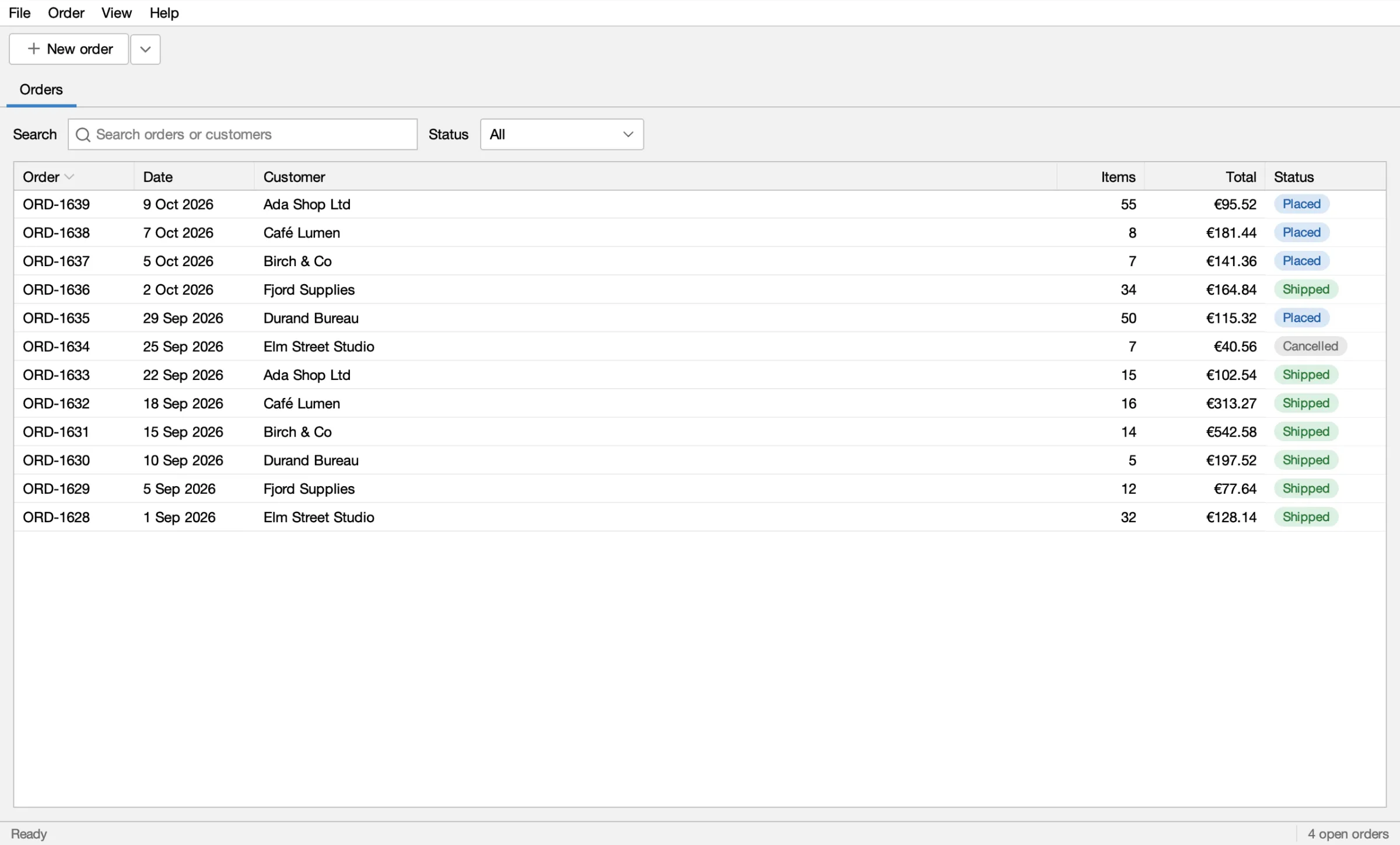
- Tour of Order Desk: the demo app every example on this site uses.
Apache-2.0 · A Kormcrete project · For coding agents:llms.txt, llms-full.txt